- Members of the House of Representatives State of Virginia (1776-79)
- Virginia Governor Patrick Henry's successor in 1779 and re-elected in 1780 but resigned in 1781 due to attack British troops in Virginia. In his tenure he wrote the statute of religious freedom (The Statute of Religious Freedom)
- American ambassador to France (1785-89)
- Secretary of State under President George Washington in 1789.
- 1801
- 1803
- 1804
- 1805
- 1807
Motivator, Politicians, President, The Founder, The Legend, United State
 |
| Thomas Jefferson Biography |
Thomas Jefferson inherited his father's property at the time of his death in 1757 and built his home, Monticello. Thomas Jefferson received an excellent education at local schools, studying Latin, Greek, French, history, and science. At age 16, he attended the College of William and Mary in Williamsburg, Virginia, graduating with top honors after two years before going to law school. He was admitted to the bar at the age of 24 years.
Thomas Jefferson married Martha Wayles Skelton a in 1772, and the couple had five daughters and one son born to die. Martha died in 1782, and Jefferson never remarried, although recent DNA evidence proved that he was the father of at least some of the six children of his slave, Sally Hemings.
Thomas Jefferson served as a lawyer in the House of Burgesses Virginia, the colonial legislature, and later at the House of Virginia. He wrote the Declaration of Independence.
Thomas Jefferson was very prolific in making many improvements judicial system and education in Virginia.
Thomas Jefferson was governor of Virginia from 1779 to 1781. He also served as Secretary of State for George Washington and Vice President John Adams. Thomas Jefferson was elected president in 1800.

Before becoming president, Thomas Jefferson also became, among other
Memory
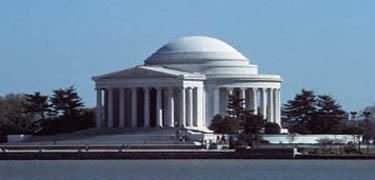
The American people remember Thomas Jefferson at the Jefferson Memorial building in Washington DC which officially opened to the public on June 26, 1934.
Controversy
Thomas Jefferson allegedly impregnated his slave, a black woman named Sally Hemmings. Based on DNA tests taken from descendants of Jefferson and Sally Hemmings is widely acknowledged that at least one, or even to six children Sally Hemmings was the son of Thomas Jefferson as well.
Events during presidency
March 4 Jefferson became the first president who was inaugurated in Washington DC
February 24 the Supreme Court in the case of Marbury vs. Madison, for the first time in the history of the state that a congressional act (laws issued by Congress) is not legally valid.
May 2 American purchased Louisiana from France (EUR 828 000 (square miles / square meter) with a price of $ 15 million dollars. Meriwether Lewis and William Clark to explore the (Far West - American West?), Exploration continued until 1806.
July 12 Alexander Hamilton died from injuries he sustained during a duel with Aaron Burr day before.
25 September Twelfth Amendment separation deciding ballot for president and vice president elections electoral (electoral college).
Decision by Essex (admiralty) The British destroyed the principle of broken voyage; England began to hold American ships carrying goods and the French and Spanish; confiscation of the goods and the arrest by British ships on behalf of the state increases.
1806 Burr Conspiracy; Gen. James Wilkinson will warn Jefferson Aaron Burr accused expedition will build a kingdom in the west of Spain.
February 19, 1807 Aaron Burr was arrested.
1 Septemer 1807 Aaron Burr was sentenced for the crime of treason.
December 14 Non-Importation Act (refusal of import laws) declared as the resistance to the British.
Navigate with the steamship Clermont-owned commercial purposes named Robert Fulton launched for the first time.
December 22 Embargo Act (embargo laws) prohibiting American ships to go into the territorial waters of other countries.
1808 officially banned slave imports.
December 7 terpiih James Madison was president.
1809 Non-Intercourse Act (issued as laws banning a relationship) applies to prohibit trade with Britain and France; officially withdrawn embargo laws.

Thomas Jefferson Quotes
The happiest moments of my life have been the few which I have passed at home in the bosom of my family.
Nothing can stop the man with the right mental attitude from achieving his goal; nothing on earth can help the man with the wrong mental attitude.
I’m a great believer in luck and I find the harder I work, the more I have of it.
Do You Know Who You Are? Don’t ask. Act! Action will delineate and define you.
Reference:
http://id.shvoong.com/law-and-politics/politics/2105701-biografi-thomas-jefferson/
http://id.wikipedia.org/wiki/Thomas_Jefferson
Austria, Dictator, German, Politicians, The Founder, The Legend

Hitler was a veteran of World War I with a lot of titles. He joined the German Workers' Party (NSDAP predecessor) in 1919, and became chairman of the NSDAP in 1921. In 1923, he staged a coup in the event known as the Munich Beer Hall Putsch. The failed coup led to the arrest of Hitler. In prison, Hitler wrote his memoir, Mein Kampf (My Struggle). After his release in 1924, Hitler had the support of the people by criticizing the Treaty of Versailles and uphold Pan-Jermanisme, antisemitism and anti-communism with charismatic speeches and Nazi propaganda. Once appointed as chancellor in 1933, he changed the Weimar Republic into the Third Reich, a one-party dictatorship based on the totalitarian ideologies of Nazism and autocratic.
Hitler's goal was to establish a New Order of absolute Nazi German hegemony in continental Europe. Until then, foreign policy and the country aims to achieve Lebensraum ("living space") for the Germanic. He ordered the German armed back and Wehrmacht invaded Poland in September 1939, led to the outbreak of World War II in Europe. Under the rule of Hitler, German troops in 1941 and its European allies occupied most of Europe and North Africa. In 1943, Germany was forced to defend himself and suffered a series of defeats in battle. In the final days of the war, during the Battle of Berlin took place in 1945, Hitler married his old lover, Eva Braun. On 30 April 1945, less than two days later, the two committed suicide to avoid arrest Red Army, and their corpses were burned.
Hitler's policies were motivated by racial supremacists and resulted in the deaths of around 50 million people during World War II, including 6 million Jews and 5 million ethnic "non-Aryans" were systematic destruction ordered by Hitler and his closest associates.
Childhood and Education

Adolf Hitler was born on 20 April 1889 at the Gasthof zum Pommer, an inn in the Salzburger Vorstadt 15, Braunau am Inn, Austria-Hungary. He was the fourth of six children of Alois Hitler and Klara pair Polzl (1860-1907). Brother and sister Hitler - Gustav, Ida, and Otto - died in infancy. When Hitler was three years old, the family moved to Passau, Germany. There he learned the dialect Bayern Downstream, instead of German Austria, which is the typical life style of speech. In 1894, the family moved again to Leonding (near Linz), and in June 1895, Alois settled on a small plot of land in Hafeld, near Lambach, where he was farming and beekeeping. Adolf attend school in the neighboring town, Fischlham. Hitler started like studying war after finding a picture book about the Franco-Prussian War his father.
Hafeld their migration to the start of a father-son conflict was intense due to Adolf refuses to comply with strict regulations in school. Alois Hitler's farming efforts at Hafeld failed and in 1897 they moved to Lambach. Hitler was 8 years old singing lessons, singing with the church choir, and even semapt consider myself to be a pastor. In 1898, the family moved permanently to Leonding. Death of his brother, Edmund, due to smallpox on February 2, 1900 greatly affected the lives of Hitler. He went from a confident figure, outgoing, and smart, a kid moody, withdrawn, sullen and often quarreled with his father and his teacher.
Alois had a successful career in the customs bureau and wanted his son to follow in his footsteps. Hitler later dramatized an event when Hitler's father took him to the customs office, calling the events that arouse antagonism mercilessly between father and son, who both are equally eager. Ignoring his son's wishes to classical high school and become an artist, Alois sent Adolf to the Realschule in Linz in September 1900. (This is the same high school who later entered Adolf Eichmann 17 years later.) Hitler rejected this decision, and in Mein Kampf, Hitler said that he did poorly in school, hoping that once his father saw "what little progress I made in school technique, he would let me pursue my dreams. "
Hitler was obsessed with German nationalism since I was young. He showed his loyalty to Germany, hated Habsburg monarchy an increasingly chaotic and administration in the occupied various ethnic empire. Hitler and his friends used the word German greeting "Heil", and sang the German anthem "Deutschland Über Alles" instead of the Austrian Imperial anthem.
After the sudden death of Alois on January 3, 1903, Hitler's achievement in school deteriorated. His mother allowed Hitler quit school in the fall of 1905. He attended the Realschule in Steyr in September 1904; behavior and improved performance. In the fall of 1905, after passing supplementary exams and final exams, Hitler left school without any desire to continue their education or build a career.
Adolescence in Vienna and Munich
Since 1905, Hitler bohemian life in Vienna financed by orphan support and help from his mother. He worked as an ordinary laborer, and a painter who sells watercolor paintings. Academy of Fine Arts Vienna twice rejected Hitler, namely in 1907 and 1908, due to "unsuitable paint". Director of the academy suggested that Hitler studied architecture, but he did not meet academic requirements. On December 21, 1907, his mother died at the age of 47. Having rejected the Academy for the second time, Hitler ran out of money. In 1909, he was living in a homeless shelter, and in 1910, he settled in a house in Meldemannstraße working poor. When Hitler tinggla there, Vienna is a place full of religious prejudice and racism. Concerns that Vienna will be met immigrants from Eastern widespread, and the populist mayor, Karl Lueger, exploiting antisemitic rhetoric for political gain. Antisemitism pan-Germanic Georg Schönerer strong support Mariahilf district, where Hitler lived. Hitler read the local newspapers, such as the Deutsches Volksblatt, burn that fuel prejudice and fear Christians who fear driven by the influx of Jewish immigrants from the east. Rejecting what he called "Jermanofobia" Catholic, he began to like Martin Luther.
The origin and when Hitler showed antisemitismenya difficult to trace. Hitler said in Mein Kampf that turned into an anti-Semitic Vienna. Her best friend, August Kubizek, claimed that Hitler was an "anti-Semitic official" before leaving Linz. Testimony Kubizek challenged by historian Brigitte Hamann, who wrote that Kubizek was the only person who says that the young Hitler was an anti-Semitic. Hamann also wrote that there is no anti-Semitic statements coming out of the mouth of Hitler at that time. Historian Ian Kershaw argued that if Hitler never said that, his word is not known as anti-Semitism in Vienna was unusual at the time. A number of sources provide strong evidence that Hitler had Jewish friends in the inn and other places in Vienna. Historian Richard J. Evans states that "historians now agree that a well-known anti-Semitismenya emerged after the defeat of Germany [World War I], as a side effect of the answer paranoid 'betrayal' of the event."
Hitler inherited the last part of the estate of his father in May 1913 and moved to Munich. Historians believe he came from Vienna to avoid conscription into the Austrian army. Hitler later claimed that he did not want to serve in the Habsburg Empire as mixing "races" within the army. After he was declared fit for duty-failed physical tests in Salzburg on February 5, 1914-he returned to Munich.
World War 1

When World War I broke out, Hitler is a resident of the city of Munich and voluntarily serving in the Army as an Austrian citizen Bayern. Placed on Reserve Infantry Regiment Bayern 16 (Regiment Group-1), Hitler's role as messengers at the Western Front in France and Belgium, to spend almost half of their time behind the front line. He was involved in the First Battle of Ypres, the Battle of the Somme, the Battle of Arras, and the Battle of Passchendaele, and was wounded at the Somme.
Hitler with fellow soldiers from the 16th Bavarian Reserve Infantry Regiment (c. 1914-1918)
He was awarded the Iron Cross, Second Class, in 1914 for his bravery. Since suggested Hugo Gutmann, Hitler received the Iron Cross, First Class, on August 4, 1918, a rare accolade pinned on the rank of someone like Hitler (Gefreiter). Work regimental headquarters Hitler, the full interacting with senior officers, it might help him get this award. Although the action is considered daring, but still can not be called very commendable. Hitler also received the Wound Badge Black on May 18, 1918.
During duty at headquarters, Hitler developed his artistic talent by drawing cartoons and instructions for an army newspaper. At the Battle of the Somme in October 1916, he was wounded in the thigh or calf left by a grenade that exploded in the trenches messengers. Hitler spent almost two months in the Red Cross hospital in Beelitz, then returned to his regiment on 5 March 1917. On October 15, 1918, Hitler was temporarily blinded due to mustard gas attack and had lodged in hospital Pasewalk. There, Hitler knew the defeat of Germany, and after getting the news, he admitted blind again.
Adolf Hitler was a soldier in the First World War (1914-1918)
Hitler became irritated by the German war effort failed and therefore also the development of ideology slowly formed. He called World War I as "the greatest experience of a lifetime" and he was praised by his commanding officer for his bravery. This experience reinforces patriotism against Germany and he was surprised by the German surrender in November 1918. Like many other German nationalists, he believed the Dolchstoßlegende (legend of betrayal), which claims that the German army "undefeated in the field" had been "stabbed in the back" on the domestic front by civilian leaders and Marxists, later dubbed " November criminals ".
The Treaty of Versailles stressed that Germany must return the number of occupied territory and mendemiliterisasi Rhineland. This agreement and the economic sanctions imposed heavy reparations on Germany. Many Germans view these agreements-particularly Article 231 which calls Germany are responsible for all the war-as an attempt to embarrass Germany. Treaty of Versailles and the economic, social, and political development in postwar Germany later exploited by Hitler for political interests
World War 2
The first diplomatic success
Alliance with Japan

Austria and Czechoslovakia
On 12 March 1938, Hitler declared unification of Austria with Nazi Germany in the Anschluss program. Hitler then turned his attention to the ethnic German population in the district of the Sudetenland in Czechoslovakia.
28-29 March 1938, Hitler held a series of secret meetings in Berlin with Konrad Henlein of Heimfront (Front of Home Affairs) Sudeten, the party of ethnic Germans in the Sudetenland. They agreed that Henlein asking for greater autonomy for the Sudeten German population to the government of Czechoslovakia, thus giving legitimacy for military action, Germany to Czechoslovakia. In April 1938, Henlein told the foreign minister Hungary that "whatever the Czech government offered, he would always ask for higher ... he wanted to sabotage an understanding with any sense because this is the only way to break up Czechoslovakia quickly". In private, Hitler considered Sudeten issue unimportant; desire is actually waging a war of conquest against Czechoslovakia.

In April, Hitler asked OKW prepare for Fall Grün ("Case Green"), code invasion of Czechoslovakia. Due to diplomatic pressure barrage of France and Britain, on September 5, Czechoslovakian President Edvard Benes launched the "Fourth Plan" for constitutional reorganization of his country to approve most requests for autonomy Sudeten.Heimfront Henlein Henlein Benes responded to the offer with a series of riots against police Czechoslovakia and led to the imposition of martial law in a number of Sudeten districts.
Germany relies on imported oil; confrontation with Britain over the disputed Czechoslovakia Germany will reduce the supply of oil. Hitler cancel Fall Grün, originally planned was held on October 1, 1938. On 29 September, Hitler, Neville Chamberlain, Edouard Daladier and Benito Mussolini held a one-day conference in Munich and the Munich Agreement which contains the producing districts surrender the Sudetenland to Germany.
Jewish shops destroyed in Magdeburg post-Kristallnacht (November 1938)
Chamberlain satisfied with the Munich conference and called it "Peace to the present", while Hitler was angered by losing the opportunity to fight in 1938, and he expressed his dissatisfaction in a speech on 9 October in Saarbrücken. In view of Hitler, who helped Britain's peace, despite satisfy German demands, was a diplomatic defeat that thwart his desire to limit the power of Britain to pave the way to the eastern expansion of Germany. Because the meeting was also elected Hitler as Man of the Year Time magazine in 1938.
In late 1938 and early 1939, the continuing economic crisis caused by Hitler's rearmament forcing massive budget cuts. In his "Export or die" on January 30, 1939, he requested the attack in order to enhance economic German foreign exchange holdings to purchase raw materials such as high-quality steel for military weapons.
On March 15, 1939, violated the Munich Agreement and may be a result of the economic crisis emphasized the need for an additional assets, Hitler ordered the Wehrmacht invaded Prague and proclaimed Bohemia and Moravia a German protectorate from Prague Castle.
The outbreak of World War II

In private discussions in 1939, Hitler declared Britain as the main enemy to defeat and destruction of Poland is a necessary prerequisite for achieving these goals. The east side will be secured and the land included in the German Lebensraum. Offended by the "guarantee" of Polish independence by Britain on March 31, 1939, Hitler said, "I have to make the demon drink for them." In a speech in Wilhelmshaven at the launch event battleship Tirpitz on 1 April, he threatened to cancel the Agreement of England-Germany if Britain continues to guarantee the independence of Poland, which he saw as a policy of "encirclement". Poland will be a German satellite state or neutralized to secure the Reich's eastern side and prevent possible British blockade. Hitler initially chose the idea of a satellite state, but because the Polish government refused, he decided to invade Poland and make it the main goal of its foreign policy in 1939. On 3 April, Hitler ordered the military preparing for Fall Weiss ("Case White"), which is planned invasion of Poland on August 25. In a speech in the Reichstag on 28 April, Hitler cancel the Sea Treaty English-German Non-Aggression Pact and the German-Polish. In August, Hitler told his generals that was originally planned for 1939, is "... to form a good relationship with Poland in order to fight the West." Some historians such as William Carr, Gerhard Weinberg and Ian Kershaw believes that the reason Hitler was waging war haste was that he was afraid he died first.
42 penny stamps Hitler in 1944. The term Grossdeutsches Reich (German Reich Kingdom) was first used in 1943 to refer to the expansion of German territory under his control.
Hitler concerned military offensive into Poland would create an early war against Britain. However, Hitler's foreign minister-and former Ambassador to London-Joachim von Ribbentrop ensure that neither Britain nor France would honor their commitments to Poland. Because secured such that, on 22 August 1939 Hitler ordered a military mobilization to Poland.
This plan requires the help of a secret Soviet non-aggression pact (the Molotov-Ribbentrop Pact) between Germany and the Soviet Union, led by Joseph Stalin, included secret agreement cleavage Poland for both countries. In response to the newly formed pact is different from the prediction-and Ribbentrop that this action will aggravate the Anglo-Polish ties-Britain and Poland English-Polish alliance on 25 August 1939. This maneuver, along with news from Italy that Mussolini would not honor the Pact of Steel, forcing Hitler to postpone invasion of Poland from 25 August to 1 September. Hitler failed to turn Britain into a neutral position by offering a non-aggression guarantee to the British Empire on August 25, and he then instructed Ribbentrop to reveal peace plan last minute with a very short time frame in order to blame the war that will take place in Britain and the unprepared Poland.
Although nervous about the intervention of Britain, Hitler's invasion of Poland to continue the plan. On 1 September 1939, Germany invaded western Poland on the grounds its claim against the Free City of Danzig and the right to extraterritorial roads across the Polish Corridor was rejected, which was handed over Germany as the Treaty of Versailles. Respond to this action, the United Kingdom and France declared war on Germany on September 3, surprising Hitler and forced asked to Ribbentrop angrily, "Now what?" France and Britain to act according to their statement, and on 17 September, Soviet forces invaded eastern Poland.
Poland will never rise again in the form of the Treaty of Versailles. It is guaranteed not only by Germany, but also ... Russia.-Adolf Hitler, public speech in Danzig at the end of September 1939
The fall of Poland was followed by what is called a journalist a "fake war" or Sitzkrieg ("sitting war"). Gauletier Poland Hitler instructed the two newly appointed northwest, Albert Forster of Reichsgau Danzig-West Prussia and Arthur Greiser of Reichsgau Wartheland, to "menjermanisasikan" their area "without question" about how. When the Polish population in the Forster area must sign a statement that they had German blood, Greiser brutal ethnic cleansing campaign against the Polish population in the region. Greiser complained Forster allowing thousands of Poles accepted as "racial" Germans thus threaten "racial purity" of Germany. Hitler refused to get involved, because I wanted to make an example of the theory of "working for the Führer": Hitler issued instructions are not clear and expect all subordinates carry out their own policies.
Other disputes arise about the methods of Himmler and Greiser, who chose the ethnic cleansing in Poland, against methods Göring and Hans Frank, Governor-General of the General Government territory of Poland, who want to transform Poland into "rice granary" Reich. On February 12, 1940, the dispute was initially done through the implementation of the method Göring-Frank, ending mass expulsions disrupt the flow of the economy. However, on May 15, 1940, Himmler wrote a memo titled "Thoughts on Handling of Foreign Residents in the East" who proposed the expulsion of the entire Jewish population of Europe into Africa and isolate Polish population to be "working class without a leader." Hitler called Himmler's memo "good and proper," and implement policies Himmler-Greiser in Poland, while ignoring and Frank Göring.
Hitler visiting Paris with architect Albert Speer (left) and sculptor Arno absorber (right), June 23, 1940
Hitler began to focus its military on Germany's western border, and in April 1940, German forces invaded Denmark and Norway. On 9 April, Hitler announced the birth of "German Reich Kingdom", that his vision of a Germanic empire nations in Europe that is united, where the Dutch, Flemish, and Scandinavian joined the government "pure race" under the leadership of Germany. In May 1940, Germany attacked France, and occupied Luxembourg, the Netherlands, and Belgium. The victory forced Mussolini to bring Italy to join Hitler on June 10. France surrendered on 22 June.
Britain, whose army was forced to leave France by sea from Dunkirk, continued to fight alongside other British colonies in the Battle of the Atlantic. Hitler offered peace to Britain's new leader, Winston Churchill, and after being rejected he ordered bombing raids to Britain. Hitler's invasion plans to the United Kingdom began with a series of air attacks in the Battle of Britain on a number of airbases and radar stations Royal Air Force (RAF) in South East England. Unfortunately, the German Luftwaffe was not able to defeat the Royal Air Force. In late October, Hitler realized that air superiority for the invasion of Britain-Operation Sea Lion-could not be achieved, then it nightly air strikes against British cities, including London, Plymouth, and Coventry.
On 27 September 1940, three Parties Pact was signed in Berlin by Saburo Kurusu of Imperial Japan, Hitler, and Italian foreign minister Ciano, [248] and then extended to Hungary, Romania, and Bulgaria, thereby strengthening the Axis powers. Hitler efforts in integrating the former Soviet Union to block anti-British failed after the meeting between Hitler and Molotov stalemate in Berlin in November, then he asked all parties to prepare for full-scale invasion of the Soviet Union.
In the spring of 1941, the military activities in North Africa, the Balkans, and the Middle East turned Hitler from his plans for the eastern region. In February, German forces arrived in Libya to strengthen the presence of Italian troops there. In April, Hitler launched the invasion of Yugoslavia, which was soon followed by the invasion of Greece. [250] In May, German forces were sent to support Iraqi rebel forces fighting Britain and invaded Crete. On May 23, Hitler issued Führer Order No. 30.
Defeat and Death

On April 20, Hitler's birthday the 56th, Hitler did the last trip of the Führerbunker ("Führer's shelter") to the surface. In the garden Reichskanzlei destroyed, he pinned the Iron Cross to Hitler Youth soldiers. On 21 April, the 1st Belorussian Front led Georgy Zhukov managed to penetrate the defenses of German Army Group Vistula led by General Gotthard Heinrici Plateau at the Battle of Seelow and drove to the outskirts of Berlin. Rejecting the situation, Hitler hanging his hopes on Waffen SS troops led by General Felix Steiner, Armeeabteilung Steiner ("Army Detachment Steiner"). Hitler asked Steiner to attack the northern side of the hill and the German Ninth Army was ordered to attack northward in the form of attacks flops.
At a military conference on 22 April, Hitler questioned Steiner attacks. He was told that the attack had never been launched and Russian troops entered Berlin. The answer is forcing Hitler to ask everyone except Wilhelm Keitel, Alfred Jodl, Hans Krebs, Wilhelm Burgdorf, and then exit ruangan.Hitler massive angry over the betrayal and incompetence of the commanders who ended with a statement for the first time-that the Germans lost the war. Hitler announced that he would remain in Berlin until the war ended, then committed suicide.
On 23 April, the Red Army surrounded the entire Berlin and Goebbels made a statement asking citizens participate defend Berlin. On that day also, Göring sent a telegram from Berchtesgaden which contains the idea that because Hitler was isolated in Berlin, he, Göring, should take over the German government. Göring set a time limit, the passing of which he considered Hitler to power again. Hitler responded by holding Göring and in his will written 29 April, Hitler declared Göring dismissed from all government positions he held. On 28 April, Hitler learned that Himmler, who left Berlin on 20 April, was trying to discuss surrender to the Western Allies. He ordered Himmler was arrested and Hermann Fegelein (Himmler's SS representative at Hitler's headquarters in Berlin) is executed.
After midnight 29 April, Hitler married Eva Braun in a small wedding ceremony in a map in the Führerbunker. After a simple breakfast with his new wife, secretary Traudl Junge he brought to another room and dictated the testament and last words. This event was witnessed and documents signed by Hans Krebs, Wilhelm Burgdorf, Joseph Goebbels, and Martin Bormann. That afternoon, Hitler was informed of the murder of Italian dictator Benito Mussolini, which may reinforce the desire to resist arrest.
On 30 April 1945, after a fierce street fighting, when Soviet troops were one or two blocks from Reichskanzlei, Hitler and Braun committed suicide; Braun bite the cyanide capsule and Hitler shot himself. Their bodies were brought up through the emergency exit door to the rear garden Reichskanzlei bunkers that have been destroyed, and then placed in a bomb crater and doused in gasoline. The two bodies then burned bombing ambiance accompanied by the Red Army.
Berlin surrendered on 2 May. Soviet archival records released after the fall of the Soviet Union-showed that the remains of Hitler, Braun, Joseph and Magda Goebbels, the six Goebbels children, General Hans Krebs and Hitler's dogs repeatedly buried and raised. On 4 April 1970, a Soviet KGB team put on the map for detailed funeral held five wooden boxes at the SMERSH facility in Magdeburg. The remains of the box is burned, destroyed, and spread Biederitz rivers, creeks Elbe.
Reference:
http://id.wikipedia.org/wiki/Adolf_Hitler
Motivator, Politicians, President, The Founder
 Biographyany | President - Name: Prof. Dr.Ing. Dr. Sc.h.c. Bacharuddin Jusuf Habibie (BJ Habibie)
Born: Pare-Pare, June 25, 1936
Religion: Islam
Title: Third President (1998-1999)
Founder and Chairman of the Board of Trustees of The Habibie Center
Wife: dr. Hasri Ainun Habibie (Married May 12, 1962)
Children: Ilham Akbar and Kemal Thareq
Grandchildren: Four people
Father: Alwi Abdul Jalil Habibie
Mother: R.A. Tuti Marini Puspowardoyo
Number of Siblings: Children's Fourth of Eight Brothers
Education B.J. Habibie:
Bandung Institute of Technology, 1954
Rheinisch Westfälische Technische Hochscule (RWTH), Aachen, Germany, with a Diplom-Ingenieur degree, cum laude predicate at the Faculty of Mechanical Engineering, Department of Aircraft Design and Construction (1955-1960).
Rheinisch Westfälische Technische Hochscule (RWTH), Aachen, Germany, with a doctorate aircraft construction, the predicate Summa Cum laude, at the Faculty of Mechanical Engineering, Department of Aircraft Design and Construction (1960-1965).
Delivering his inaugural speech professor of aircraft construction in the Bandung Institute of Technology, in 1977.
Work B.J. Habibie:
Head of Research and Development of Structural Analysis in the company Hamburger Flugzeugbau Gmbh, Hamburg, Germany between the years 1965-1969.
Chief, Division of Methods and Technology on Commercial and Military Transport Aircraft MBB Gmbh, Hamburg and Munich between 1969-19973
Vice President and Director of Technology at MBB Gmbh, Hamburg and Munich in 1973-1978
Senior Advisor to the Board of Directors Technology MBB 1978.
Return to Indonesia and Pertamina's Advanced Technology Division lead, which is the forerunner of BPPT, years 1974-1978.
Government of Indonesia in the Field Advisor Technology Development and Aircraft, responsible directly to the President of Indonesia Suharto in 1974-1978.
State Minister for Research and Technology (Research and Technology) and Chairman of the Agency for the Assessment and Application of Technology (BPPT) in 1978-1998.
Vice President R.I. on 11 March 1998-21 May 1998.
May 21 President 1998-20 October 1999.
Organization:
Founder and Chairman of ICMI
Awards:
Theodore van Karman Award
The third President of the Republic of Indonesia, Jusuf Habibie Bacharuddin born in Pare-Pare, South Sulawesi, on June 25, 1936. He was the fourth child of eight siblings, spouse Alwi Abdul Jalil Habibie and RA. Tuti Marini Puspowardojo. Habibie, who is married to Hasri Ainun Habibie on May 12, 1962 was blessed with two sons namely Ilham Akbar and Thareq Kemal. Habibie passed his childhood with his brothers in Pare-Pare, South Sulawesi. The nature firmly adhered to the principle has been demonstrated Habibie since childhood. Habibie, who had a penchant for horseback riding and reading is known to be very smart when they occupied the elementary school, but he had lost his father, who died on 3 September 1950 due to a heart attack while he was praying Isha.
Shortly after his father died, his mother and then sell the house and car and moved to London with Habibie, after the death of his father, his mother drudge finance his children's lives, especially Habibie, as a willingness to learn Habibie later studying at Gouvernments Middlebare School. In high school, he began to look outstanding achievements, especially in the exact sciences lessons. Habibie a favorite figure in the school.
Because of his intelligence, Having graduated from high school in Bandung in 1954, he entered at the ITB (Bandung Institute of Technology), he did not until the end there because he got a scholarship from the Ministry of Education and Culture to continue his studies in Germany, because of the Bung Karno message about the importance of Air and Flight to Indonesia so he majored in Aerospace Engineering with specialization in aircraft construction Rhein Westfalen Technische Hochschule Aachen (RWTH) When I got to Germany, he was determined to sincerely dirantau and be successful, given the mother's efforts to finance college and life day-to-day. A few years later, in 1955 in Aachean, 99% of Indonesian students there are given a full scholarship. Only she who has a green passport or private from his friends another holiday season is not just a golden opportunity for him to be filled with exams and earn money to buy books. After the holidays, all activities except learning aside. In contrast to other friends, they, more often used the summer vacation time to work, gain experience and money without following the exam.
He received his Diploma Ing, from the Technische Hochschule, Germany in 1960 with honors Cumlaude (Perfect) with an average value of 9.5, with an engineering degree, he signed up to work in firm Talbot, a German railway industry. At that time the firm Talbot require a large volume wagon for transporting lightweight goods but the volume is huge. Talbot require 1000 wagon. Got a question like that, Habibie tried to apply the methods of construction to make aircraft wings which he applied to the wagon and finally succeeded.
After that he then continued his studies for a PhD at the Technische Hochschule Fuer Die Facultaet Maschinenwesen Aachean Habibie later married in 1962 in Hasri Ainun Habibie, which was then brought to Germany, his life harder, in the early morning Habibie sometimes had to walk quickly to the much work needs to save his life and then go home at night and study for college, his wife Lady Hasri Ainun Habibie had to queue up in the wash for the public to wash clothes economize needs of family life. In 1965 Dr Habibie earned. Summa cum laude rated Ingenieur (It perfectly) with an average of 10 of the Technische Hochschule Fuer Die Facultaet Maschinenwesen Aachean.
The formula is found by Habibie called "Habibie Factor" because it can count cracks or krack propagation on random atoms to the plane that he was dubbed as "Mr. Crack". In 1967, to honor Professor (Professor) at the Institute of Technology Bandung. from the same place in 1965. Genius and achievement is what drove Habibie recognized among international agencies, Gesselschaft fuer Luft und Raumfahrt (Institute of Aeronautics and Space) Germany, The Royal Aeronautical Society, London (UK), The Royal Swedish Academy of Engineering Sciences (Sweden), The Academie Nationale de l'Air et de l'Espace (France) and The U.S.
Academy of Engineering (USA). Meanwhile prestigious award ever achieved Habibie them, Edward Warner Award and von Karman Award which is almost equivalent to the Nobel Prize. Domestically, Habibie received the highest award from the Institut Teknologi Bandung (ITB), Ganesh Bhakti Praja Manggala Kencana.
Steps Habibie much admired, full of controversy, a lot of admirers but not a few who did not agree with him. Each time, the winner of the prestigious Theodore van Karman Award, is back from the "habitat" of the Germans, he was always in the news. Habibie just a year studying at ITB Bandung, 10 years of college until my doctorate aircraft construction in Germany with honors Summa Cum laude. Then work in the aircraft industry leading MBB Gmbh Germany, prior to the call of President Soeharto to return to Indonesia.
In Indonesia, Habibie 20 years as Minister of State for Research and Technology / Chief BPPT, leading the 10 companies owned strategic industries, selected MPR became Vice President, and was sworn in by the Chief Justice to replace President Suharto became President of the Republic of Indonesia to the 3. Suharto handed the presidency to Habibie under Article 8 of the 1945 Constitution. Until finally forced Habibie also resigned due to referendum East Timor voted for independence. MPR his accountability speech was rejected. He went back to ordinary citizens, restored live migrated to Germany.
On May 22, 2010, Hasri Ainun Habibie, the wife of BJ Habibie, died at the Hospital Ludwig-Maximilians-Universitat, Klinikum, Munich, Germany. He died on Saturday at 17.30 local time or 22:30 pm. Certainty of death Hasri Ainun Ali Mochtar Ngabalin certainty, a former member of Parliament appointed deputy BJ Habibie family. It's a very deep sorrow for the former Indonesian President Habibie and people who feel lost. For Habibie, Ainun is everything. Ainun are eyes to see her. For Ainun Habibie is everything, filling you in his life. But every story has a end, every dream has a limit.
In early December 2012, a movie called "Habibie and Ainun" was launched, the film is a true story about romance Lifting both as a teenager to become husband and wife, and when death separates them. The film is taken from the work of BJ Habibie's bestseller, this film worked on by two directors, namely Faozan Rizal and Hanung Bramantyo, with actor Reza Rahardian as Habibie and Justin Lestari as Ainun Habibie.
Most of his work in calculating and designing several aircraft manufacturing project:
* VTOL (Vertical Take Off and Landing) DO-31 Transport Aircraft.
* Military Transport Aircraft Transall C-130.
* Hansa Jet 320 (Executive Aircraft).
* Airbus A-300 (for 300 people)
* CN - 235
* N-250
* And indirectly participated in the count and design:
· BO-105 helicopter.
· Multi Role Combat Aircraft (MRCA).
· Some projects missiles and satellites.
Some Signs Service / honors:
* 1976 - 1998 Director of PT. Nusantara Aircraft Industry / IPTN.
* 1978 - 1998 Ministry of Research and Technology of the Republic of Indonesia.
* Chairman of the Agency for the Assessment and Application of Technology / BPPT
* 1978 - 1998 Director of PT. PAL Indonesia (Persero).
* 1978 - 1998 Chairman of the Industrial Development Authority Batam Island / Opdip Batam.
* 1980 - 1998 Chairman of the Defense and Security Industry Development (Presidential Decree. 40, 1980)
* 1983 - 1998 Director, PT Pindad (Limited).
* 1988 - 1998 Vice Chairman of the Board of Trustees Strategic Industries.
* 1989 - 1998 Chairman of the Management Board Strategic Industries / BPIS.
* 1990 - 1998 Chairman of the Association of Muslim Scholars se-lndonesia/lCMI.
* 1993 Daily Presidium Coordinator, Board of Trustees of Golkar.
* March 10-May 20 1998 Vice President of the Republic of Indonesia
* May 21, 1998 - October 1999 the President of the Republic of Indonesia
Youth

Prof. DR (HC). Ing. Dr. Sc. Mult. Bacharuddin Jusuf Habibie otherwise known as BJ Habibie (73 years) is a man Pare-Pare (South Sulawesi) born June 25, 1936. Habibie became president of the 3rd Indonesia for 1.4 years and 2 months to be Vice President to-7. Habibie is a "blaster" between the Javanese [mother] with the Napier / Pare-Pare [father].
The days of small, Habibie has shown intelligence and high spirits on science and technology, particularly physics. For six months, he enrolled at the Mechanical Engineering Institute of Technology Bandung (ITB), and continued to Rhenisch Wesfalische Tehnische Hochscule - Germany in 1955. With financed by his mother, R.A. Tuti Marini Puspowardoyo, young Habibie spent 10 years to complete the study of S-1 to S-3 in Aachen-Germany.
Unlike the average Indonesian students get scholarships abroad, college Habibie (especially S-1 and S-2) funded directly by the mother who does catering business and Indekost in London after her husband left to go (Habibie's father). Habibie mengeluti field of aircraft design and construction at the Faculty of Mechanical Engineering. During the five years of study in Germany Habibie finally earned his diploma Dilpom-Ingenenieur or technique (note: diploma engineering in Germany is generally equated with a degree Master/S2 in other countries) with summa cum laude.
Pak Habibie continued doctoral program after marrying his high school friend, Mrs. Hasri Ainun Besari in 1962. Together with his wife living in Germany, Habibie had to work to pay for tuition as well as household costs. Habibie explore the field of Aircraft Design and Construction. In 1965, Habibie S-3 completed his studies and received his PhD Ingenieur (Doctor of Engineering) with a GPA summa cum laude.
Career in the Industry
During his doctoral student, BJ Habibie had started working for his family and cost studies. After graduation, BJ Habibie worked at Messerschmitt-Bolkow-Blohm MBB or Hamburg (1965-1969 as Head of Research and Development on Aircraft structure of the analysis, and then served as Head of the Division of Methods and Technology in industrial commercial and military aircraft in MBB (1969 - 1973). kebriliannya top performance and, four years later, he was believed to be the Vice President and Director of Technology at MBB period 1973-1978 and a Senior Penasihast technology to the Board of Directors MBB (1978). was he the only Asians who occupied number two position in the German aircraft company.Before entering the age of 40 years, Habibie was very brilliant career, especially in the design and construction of aircraft. Habibie be a "jewel" in the country Germany and he got "an honor", both materially and intellectually by the Germans. While working in MBB Germany, Habibie contributed various research results and a number of theories for science and technology in the field of Thermodynamics, Construction and Aerodynamics. Several theoretical formulations known in the aircraft as "Habibie Factor", "Habibie Theorem" and "Habibie Method".
Return to Indonesia

Habibie began to really focus after he fired a high position in the German MBB Aircraft Company in 1978. And since then, from 1978 to 1997, he was appointed Minister of State for Research and Technology (Research and Technology) as well as serving as Chairman of the Agency for the Assessment and Application of Technology (BPPT). Besides, Habibie was also appointed as Chairman of the National Research Council and various other positions.
CN-235 aircraft owned by Air Force works IPTN Spain

"I have some figures roomates compare the cost of one kilo of airplane Compared to one kilo of rice. One kilo of airplane costs thirty thousand U.S. dollars and one kilo of rice is seven cents. And if you want to pay for your one kilo of high-tech products with a kilo of rice, I do not think we have enough. "(Source: BBC: BJ Habibie Profile -1998.)
The sentence above is Habibie weapon to argue with his political opponents. Habibie would like to explain why the tech industry is very important. And he compares the prices of products from high-tech industries (high tech) and agricultural products. He showed data that the price of 1 kg aircraft is USD 30,000 and 1 kg of rice is 7 cents (USD 0.07). This means that 1 kg aircraft is almost equivalent to 450 tonnes of rice. So by making 1 piece of the plane with a mass of 10 tons, will be obtained rice 4.5 million tonnes of rice.
Pak Habibie mindset welcomed by Mr. Harto.Pres. Suharto was willing menggangarkan extra funds from the state budget for the development of technology projects Habibie. And in 1989, Suharto gave "power" over the Habibie Habibie by giving confidence to lead strategic industries such as Pindad, PAL, and PT IPTN.
Habibie became RI-1

Three years after his return to Indonesia, Habibie (age 41 years) received the title of Professor of Engineering from ITB. Over the past 20 years as the Minister, finally, on March 11, 1998, Habibie was elected as Vice President for-7 through the General Assembly. At the time that the economic crisis (financial crisis) hit the Asian region, including Indonesia. The rupiah plummeted from Rp 2,000 per U.S. dollar to Rp 12,000 per dollar's. Foreign debt maturities so that swell due to the depreciation of the rupiah. This diperbarah by private banks experiencing liquidity problems. Inflation soared above 50%, and unemployment started to happen everywhere.
At the same time, public outrage peaked with the new order system is loaded corruption, collusion, nepotism committed by Suharto cronies (officials, politicians, tycoons). Besides corruption, authoritarian Suharto government classified, which captures vocal activists and students.
Triggered shooting 4 students (Tragedies) on May 12, 1998, public outrage erupted, especially among activists and students in the New Order government. The movement of students, activists, and all the people at 12-14 May 1998 be a momentum change of the regime leader Mr Hato. And on May 21, 1998, President Suharto was forced to retire from the post of president which he held for about 32 years. During the 32 years that, authoritarianism and corruption grew sumbur loaded. During the 32 years of that, many truths are silenced. Starting from the turn of the Sukarno government (and exile Pres Sukarno), G30S-PKI, Supersemar, until Soeharto alleged conspiracy with the U.S. and its allies to dredge the natural resources by the people, the capitalists under the banner korpotokrasi (including the CIA, Duni Bank, IMF and conglomerate ).
Suharto's resignation, then his Deputy that BJ Habibie was appointed the third President under section 8 of the 1945 Constitution. However, his tenure as president lasted only 512 days. Although very short, the leadership of President Habibie of Indonesia was able to bring back from the brink of collapse due to the crisis. President Habibie successfully led the country out of the ultra-crisis situation, to implement the transition from otorian country into democracy. Successfully conducting the 1999 elections with multi parti (48 parties), successfully brought a change signifikn on stability, democratization and reform in Indonesia.
Habibie was the first president of Indonesia who received many awards, especially in the field of science and technology both domestically and abroad. His services in the field of aircraft technology to deliver he received an Honorary Doctorate degree (Doctor of Honoris Causa) from the University berbagaai world leading, among others, Cranfield Institute of Technology and Chungbuk University.
Special Notes BJ Habibie

"Carry only your job well, I pray that Allah SWT is always protected Habibie in performing the task. We will meet in the inner course, "answered Soeharto refused to meet with Habibie in a phone call on June 9, 1998.
(Habibie: Decisive Moments. Pages 293)
One of the common questions and many people do not know is how Habibie who lives on the island of Celebes could meet and familiar with Suharto who spent most of his life in Java?
Habibie first meeting with Suharto occurred in 1950 when Habibie was 14 years old. At that time, Suharto (Lieutenant Colonel) came to Napier in order to combat the insurgency / separatist in eastern Indonesia during the Sukarno government. Lieutenant Colonel Suharto lived opposite the family home Alwi Abdul Jalil Habibie. Since the mother is the Javanese Habibie, Suharto was then (Javanese) were received very well by the Habibie family. In fact, Suharto participate Habibie was present when my father died. In addition, Suharto was a "matchmaker" Habibie sister's wedding with men (soldiers) Lieutenant Colonel Suharto. Proximity-Habibie, Suharto continued despite Suharto had returned to Java after successfully combating the insurgency in eastern Indonesia.
After Habibie completed the study (about 10 years) and worked for almost 9 years (a total of 19 years in Germany), Habibie finally called back to their homeland by Soeharto. Although he was not awarded a scholarship to study in Germany from the government, Mr. Habibie still willing to go home to serve the country, especially the request comes from the fact Soeharto was 'a teacher' for Habibie. Habibie decided to return to Indonesia to give knowledge to the people of Indonesia, back to build high-tech industry in the archipelago.
Together Ibnu Sutowo, Habibie came back to Indonesia and met with President Soeharto on January 28, 1974. Habibie proposes the idea of development as follows:
The idea of building the aircraft industry nationwide as spearhead strategic industry
The idea of establishing a Center for Research and Development of Science and Technology (Puspitek)
The idea of the Agency for the Assessment and Application of Science of Technology (BPPT)
Habibie initial ideas feed into Soeharto and Habibie began to materialize when it served as a minister of the period 1978-1998.
However, the days of old, the relationship Habibie-Suharto apparently cracked. This is because the policies Habibie who allegedly "humiliating" Soeharto. The dismissal of Lt. Gen. (ret.) Prabowo from office because mobilize troops Kostrad Kostrad to Jakarta (and Brass Castle) without coordination boss is one policy that 'painful' pack Harto. Though Prabowo was Soeharto's favorite son who had been educated and nurtured into Suharto's successor. Examination as graft suspect Tommy Soeharto helped create 'hot' with BJ Habibe government policies, especially on several occasions in the media, BJ Habibie gave the green light to examine Soeharto. Though Tommy is the son of 'gold' Soeharto. And so many opposed to the Suharto government policy in the field of press, politics, the law until the unconditional release of political prisoners such as Sri Bintang Pamungkas Soeharto and Mukhtar Pakpahan.
Habibie: Mr. Technology Indonesia *
 |
| B.J. Habibie |
On 26 April 1976, Habibie established PT. Aircraft industry and became the first aircraft industry in South East Asia Region (note: Mr. meruapakan Nurtanio Aircraft Industry Pioneers Indonesia). Aircraft Industry renamed Nusantara Aircraft Industry (IPTN) on October 11, 1985, then direkstrurisasi, became Dirgantara Indonesia (PT DI) on Agustuts 2000. Istimewapun treatment experienced by other strategic industries such as PT PAL and PT PINDAD.
Since the establishment of the state statregis industries, each year Soeharto government has budgeted a relatively big budget to develop high-tech industries. And budget with very large numbers issued since 1989 where Habibie led strategic industries. However, Habibie has a logical reason to start the high-tech industry, would require a huge investment for a period of time. Results may not be felt immediately. Planting durian trees only took 10 years to harvest, especially high-tech industry. Therefore, over the years the style of strategic industry Habibie has yet to yield and consequently the country continues to finance the operating costs of the strategic industries is quite large.
Strategic industries ala Habibie (IPTN, Pindad, PAL) ultimately deliver results such as airplanes, helicopters, weapons, skills training and maintenance services (maintenance service) for aircraft engines, ammunition, ships, tanks, armored vehicles, rifles caliber , water cannons, RPP-M vehicles, combat vehicles and much more both for civilian and military purposes.
For international scale, BJ Habibie involved in various design and construction projects such as aircraft Fokker F 28, Transall C-130 (military transport), Hansa Jet 320 (executive jets), Air Bus A-300, DO-31 transport aircraft (aircraft technology dangn land and take off vertically), CN-235 and CN-250 (aircraft with the technology fly-by-wire). Moreover, Habibie indirectly involved in the project design calculations and BO-105 helicopter type, multi-function fighter aircraft, some missiles and satellites.
Because the mindset is, I consider him as the father of the technology Indonesia, liberated how much success a la Habibie strategic industries. Because we know that in 1992, the IMF instructed not to give Soeharto to IPTN operating funds, so that when it IPTN began entering a critical condition. This is because the plan makes satellite Habibie himself (note: the 1970's Indonesia is the country's 2nd largest satellite usage), the plane itself, as well as its own military equipment. It is supported by 40 0rang Indonesian experts who have work experience in the satellite manufacturer Hughes Americans will be drawn back to Indonesia to develop high-tech industry in Indonesia. If this is true, then this will threaten American technology industry (reducing the market share) as well as concerns high-tech capabilities and the Indonesian military.
Reference:
http://kolom-biografi.blogspot.com/2009/01/biografi-bj-habibie.html
http://nusantaranews.wordpress.com/2009/04/02/biografi-bj-habibie-bapak-teknologi-dan-demokrasi-indonesia/
Top 5 Popular of The Week
-
 TobaTimes - Sungguh gila dan memprihatinkan. Pergaulan siswa SMP di Samarinda, Kalimantan Timur, semakin liar. Mereka tak segan-segan berbua...
 -
 Anjaam (1994) Movie Mp3 Songs Badi Muskil Hai_Anjaam Download Barson Ke Bad_Anjaam Download Channe Ke Khet Main_Anjaam Download...
 -
 TobaTimes - Seorang gadis remaja yanga bahenol berusia 15 tahun, dicabuli DD (30), seorang mandor sebuah perusahaan perkebunan di Desa Mend...
 -
 Berikut ini Adalah Biodata Fraser Forster Lengkap, Penjaga gawang Timnas Inggris, biodata-artisidolaFraser Forster Biografi Fraser Forster � Lahir di kota Hexham, Inggris, tepatnya pada tanggal 17 Maret 1988. Fraser sendiri adalah seorang ...
 -
Diduga disekap majikannya JOMBANG – Persoalan Tanaga Kerja Indonesia (TKI) tak ada habisnya, Kali ini menimpa Dewi Fitri (21) warga Dusun Ge...
-
Sinopsis Pangako Sa’yo (Janjiku) MNCTV - Kisah Pangako Sa’yo berawal dari Amor de Jesus yang merupakan mahasiswi keperawatan yang bermimpi m...
-
 Beberapa pasangan dapat hamil dengan mudah, sedangkan pasangan lainnya merasa kesulitan untuk hamil. Sebenarnya adanya kesulitan untuk hamil...
 -
 Kumpulan Full Album Lagu NDX AKA Mp3 Terbaru dan Lengkap 2018 | NDX AKA ialah kumpulan penyanyi hiphop Indonesia yang memiliki bakat dan ...
 -
 Menjadi kebanggaan sendiri ketika orang tua memajang foto anak-anaknya di media sosial. Namun, tahukah Anda? Ternyata tidak semua anak menyu...
 -
 Penggemar berat film Bollywood mustahil tak tahu film romantis yang satu ini, Kuch Kuch Hota Hai. Ya, film yang dibintangi Shah Rukh Khan, K...